Category: Philosophical Methodology
The political rhetoric of reason

A certain view of politics conceives of it as a convincing, by pen or gun. Certainly political philosophy lends itself well to this conception, being, as it is, in the business of convincing the reader the truth of the political conclusions offered by the text. One succeeds as a political philosopher when one convinces their interlocutor that one’s proposed system of politics rises above all others. One succeeds as a professional philosopher when one convinces their colleagues that one’s ideas are meritorious, either because they are true or, as is more likely, because they substantively further the interminable dialogue of the profession.
On a certain very cynical conception of politics, one will take this convincing to be rhetorical rather than truth-seeking. Rhetoricians convince without regards to the truth of what they convince. What differentiates the rhetor from the philosopher is the latter’s concern for the truth, regardless of how (un)convincing it might appear. One need not look far for examples of the counterintuitive in political philosophy. Nozick argues that taxation is tantamount to theft and, indeed, slavery. Marx argues that a voluntary, free labor contract between a worker and their employer is fundamentally exploitative. Rawls argues that wealth inequality is preferable to equality because it makes the worst-off better-off in absolute terms. But of course it is not merely enough to state the counterintuitive and expect assent. All three philosophers proceed from assumptions which ostensibly demand compliance from any reasonable human, and go on their merry way demonstrating the implications of such assumptions.
The problem with rhetoric in the written form: one must meet their audience as they come. A text on its own permits no discretion as to who partakes in its contents (well, at the very least they must be literate). A political community must meet its audience as they come. A society on its own permits no discretion as to who partakes in its practices and institutions. At this juncture it must be clarified that these are idealizing assumptions which presuppose an impossible independence between language and its participants, between a society and its citizens, when of course these categories are mutually constitutive. A text prefigures its audience just as a society prefigures those who live in it. The reader introduced to language takes up well-worn conventions which undergird even their most elaborate experimentations with the word. The citizen introduced to society develops their characteristic habits in context of social practices and institutions — via education, religion, media exposure, and so forth. But idealizing assumptions are appropriate when investigating the logic of a discourse — of politics and political philosophy — which conceives of itself in the ideal, as the derivation of what ought to be without necessary regard for what is. And in investigating the idealizing logic of such a discourse, with the recognition that its methodological presuppositions are not quite borne out in the world, we may produce a systematic clarity with regards to its contents. So we return to the idealized problematic of rhetoric and politics: one must meet their audience as they come.
There is nothing complex about this problem. K. believes fundamentalist religious doctrine should serve as the law of the land; M. ,an atheist, thinks religion ought be abolished. A political philosopher must convince both of a single conclusion; a legislator must convince both to obey the same law. If we could speak face-to-face with K. and M. we would tailor our talking points to their particular character. To K. we might focus on doctrinal reasoning against the notion that religious law should serve as general law, that to think of such debases the divine, that in any case it would only foment further religious persecution, and so on. To M. we might focus on the infeasibility of such drastic reform, on the requirements of pluralism in a democratic society, on the possibility of separating religious life from secular life, etc. In being able to address the particularity of K.’s and M.’s concerns our rhetoric achieves maximal effectiveness, for, in a manner of speaking, we know and can choose exactly what buttons we need to press. But in our writing we are agnostic to such particularity in our readers. Rawls’ veil of ignorance is instructive. The veil of ignorance serves not just as a conceptual tool for analyzing political arrangements but also as a reflection upon the position of the author in relation to her readers. She knows naught of their desires, dispositions, dreams, and yet must meet all of these as they come. What to do?
A more thorough cynic, or perhaps skeptic, would argue that reason was invented precisely to solve this problem: that it is merely a subset of rhetoric which aims to address all people — all rational beings — rather than individuals or smaller groups, and that truth is just shorthand for a universally-applicable rhetoric. And some truth indeed lies behind this cynicism. Reason gives one access to a technique of convincing which, unique among all other such techniques, can convince anybody. Specifically, reason binds anybody, insofar as they are rational, which really amounts to a tautology: reason binds all for whom reason is binding. The power of it is that it is so hard, so undesirable to be irrational, and even to ask why one ought to be reasonable amounts to a performative self-contradiction. The issue cannot even be formulated and, when we try, we find out we have been playing reason’s game all along. To convince someone strictly through reason amounts to providing a valid proof without premises (in the strongest case) or, at the very least, a proof with premises everybody should or actually does accept (a case which might, upon analysis, turn out to be equivalent to the former). Regardless of anything else about a person, they cannot help but accept a valid proof with no premises — at least insofar as we can communicate with them at all. One who cannot be compelled by reason, we think, cannot be compelled by anything.
It is banal to say that one can investigate the presuppositions of a political philosopher by analyzing what goes into their concept of a rational being. The key to all of Hobbes lies in his conception of a rational human abstracted away from society: a self-interested actor who places supreme value on their self-preservation, and who pursues this interest by any means necessary. From this mostly-formal conception of a rational human, everything else about the Hobbesian architectonic falls into place: the sacrifice of freedom toward the maximization of self-preservation via the social contract. The State as omnipotent and omniscient protector. Leviathan.
Banal because what we are really saying is that the philosopher becomes a rhetor. The transformation occurs, from Dr. Jekyll to Mr. Hyde, when substantive features of an audience are snuck in to what supposedly should apply to any audience at all. One reads Hobbes and wonders, how could it be that one sees all humans as being so close-minded, so selfish? I am not such a human; nor my family; nor my friends. One objects to the Hobbesian account of rationality, which purported to describe a universality inherent in all beings, on the grounds that it has failed to deliver on such universality. A single counterexample crumbles the whole elaborate structure because the point was not to deliver an empirical generalization of behavior, open to exception, but rather a normative ground for the legitimacy of behavior.
Why have we not focused on human nature? We very well might have; it functions quite similarly in providing an axiomatic basis for the derivation of conclusions about just political society. It is likely right to conceive of rationality as one of the features comprising human nature — for some philosophers, as the exclusive feature comprising human nature. The reason to emphasize rationality in particular is to highlight the logic of political philosophy, its constitutive form. Within the content of their theories, political philosophers may very well appeal to human nature as the substantive basis for their conclusions. But even if the political philosopher takes the content of their theories to follow from an account of human nature, such an account must itself follow from rationality, because it must be able to convince any reader of their text. If the account of human nature appealed to could not convince a rational reader, then we are left with the aforementioned problem of Hobbes, in which we might simply deny whatever aspects of human nature are not rationally binding. Indeed, perhaps the only component of human nature which cannot be reasonably denied is that of rationality. Regardless of content, what formally constrains political philosophers is the requirement that their argument be convincing to any who might read their work. For it is precisely the goal of the political philosopher, who seeks not only some abstract truth of the matter but to make such truth operative in the world, to convince their audience of their position’s legitimacy.
The necessity of convincing most apparently binds the philosopher of democracy, for whom the fact that a member of the polis might not assent to its laws presents an obvious objection. One who grounds political legitimacy directly in the will of the governed would surely see a failure of assent as damning. But even those who do not must yet do some convincing. Plato had to convince the philosopher-kings. And even the most antidemocratic thinker must end up convincing themselves with their theorization.
Such self-convincing cannot be presumed on the basis that one must tautologically be convinced by one’s own beliefs. In a sense this is obviously true. But one can only find their own beliefs convincing insofar as they are justified. And justification, in order to function as such, must appeal to some public and non-individual criteria. For suppose it did not — that justification could appeal only to some private knowledge to which the despot had privileged access, and which was inarticulable in terms of public reason. Would the despot, in this case, find their politics justified by merit of a particular sensation which corresponded to their entertainment of some political conclusion or another? (e.g. “it seems right to me that. . .”). How would they know that such particular sensation was really a sensation of feeling-right-that? And how could they confirm that their particular sensation at an earlier time was the same as their particular sensation at a later time? And what if their sensations came into conflict?
In short: even a despotic political regime must be reasonably convincing. But insofar as the despot may be convinced of their regime, and insofar as such convincing takes place in the space of public reason, then — assuming such convincing has proceeded legitimately — is it not the case that all reasonable beings should assent to it? It turns out we have no despotism, after all, for a despot with the assent of the governed ends up being a democratic ruler. Democracy inevitably awaits us at the conclusion of our inquiry as the only possibly legitimate form of political governance; it ends up that all we must flesh out are its contents.
Breaking intuition’s chains (part 2)

How, then, should we conceive of intuition in relation to our inquiry? The mistake, to make it quite explicit, involves the introduction of a dichotomy at the heart of intuition. One takes it that an intuition has particular content, generally a proposition. Such content presents itself in a particular manner — say, according to a certain causal history, and with a certain feeling of plausibility — which we might call its form. An intuition has content, the fact at which it points, and form, which is the fact of the intuition itself as a psychological event. The unresolvable issue, then, becomes the relationship between the form and the content of the intuition. Anti-intuitionists like Della Rocca argue that intuition must be condemned if its form bears suspect relation to its content. One who intuits that “abortion is immoral” merely because they have been primed to the plausibility of such belief, e.g. by a certain religious upbringing, cannot justifiably infer the truth of such intuition’s content: namely that abortion is immoral. After all, one may be primed to the plausibility of many false beliefs, as shown by the history of the sciences. An intuition thus has no necessary connection to the truth of its content, and insofar as it does have such connection we still need to appeal to alternate methods of justifying this content; the intuition falls out of the picture. A thoroughgoing anti-intuitionist would claim that the form inherent to all intuition — its seeming certainty or appeal — has no relation to the truth of its content, but rather comes about as a result of certain psychological features of ourselves at the point in time at which intuition strikes us.
We may go a step further from such negation of intuition which, true though it may be, only presents us a case in which thought falters and stops short of completing the project at which it aims. And there must be some way to make sense of these damnable coercions of thought which strike one as lightning bolts setting the mind ablaze. In a not altogether different context Benjamin writes that “in the fields with which we are concerned, knowledge comes only in lightning flashes. The text is the long roll of thunder that follows” (The Arcades Project, N). One must make sense of the legitimate progression from the lightning flash of intuition to the thunder which follows. A child is taught to count the seconds between the flash and the rumble, and in doing so to grasp the location of the storm by a particular schema: 3 seconds = 1 km. The task the philosopher must set upon is to construct such schema as proper to the understanding of an intuition.
Spinoza offers his example of a human body under the sun, a foundation as good as any to work from (Ethics, s2, p35). One glances up from their walk and sees a bright yellow circle situated about 200 feet away embedded in the sky like a shining hole. Here, after all, is where divinity has punctured through. One may intuitively believe this to be the case. No matter how hard one tries, it may be impossible to shake the feeling that the sun lies hundreds rather than billions of feet away. Spinoza points out that strictly speaking such a feeling and the corresponding desire to make an inference about distance are not at all false. These are true psychological facts explained by the interaction between the body of the sun and the body of the person in question. The sun really does present itself as a nearby golden orb given the particular effect it produces on the human sensory system.
It is only a smidge better to declare such presentation false as to hold, based on its immediate plausibility, that the inference such presentation seems to permit (that “the sun is 200 feet away”) is true. The substantial question rather involves assessing what bodies must be like in order for their relation to produce such effect. We may imagine a quite sophisticated explanation which assesses just that: burning 93 million miles away a gaseous star emits rays of light which strike the cones of the eye and trigger neurological responses so as to give the impression that the source of the image lies only 200 feet away. Such explanation demonstrates the relationship between the form of the intuition and its content, showing how the particular manner in which the intuition presents itself (in this case via the complicated story we tell about the relation between the body of the sun and the body of the person) produces its content (in this case the effect of the sun upon the person producing the sensation that they are only 200 feet apart). The content is true inasmuch as we understand its truth to involve the effect produced by one body upon another under certain determinate circumstances (the glancing at the sun), and false inasmuch as we understand its truth to involve the properties of a particular body apart from such a relation, e.g. as a fact about the sun’s distance from the earth — as an essential property of the sun in its spatiotemporal position. At this juncture we are always tempted to fall into reification due to its overwhelming simplicity. Much simpler to say we perceive the sun as hanging up in the sky 200 feet away because, in actuality, the sun hangs up in the sky at such a distance. Much more of an ordeal to articulate such perception as a relation between bodies. And ever we are tempted toward simplifications, though they invariably give out under the weight of their insubstantiality.
Everything falls out of joint when one proceeds from the content of an intuition and attempts to deduce the legitimacy or significance of such intuition on this basis. It strikes one as obviously right that one should pull the lever in the trolley problem. One experiences this effect upon one’s body in its encounter with the thought experiment; experiences a sensation of plausibility corresponding with the entertainment of the proposition that “one ought pull the lever in the trolley problem.” Thus far all is well and good. One errs in presuming that this effect, the plausibility, proffers knowledge of the proposition simply because its entertainment in the mind correlates with such plausibility — that the plausibility of the proposition that “one ought to pull the lever in the trolley problem” implies that one ought to pull the lever in the trolley problem. We are again in the case where the plausibility that “the sun lies 200 feet away in the sky” supposedly implies that the sun lies 200 feet away in the sky. We mistakenly proceed from the effect to the cause in our botched attempt to inquire as to the conditions for the possibility of our intuition.
Breaking intuition’s chains (part 1)
The tradition of all dead generations weighs like a nightmare on the brains of the living.
Marx, The Eighteenth Brumaire of Louis Napoleon, 1852
Wont to think of intuition as Avicenna did, a divine illumination, a serendipitous co-harmony between our limited intellect and the celestial emanations, an experience rather like surfacing for air, we should remind ourselves that we drown in it. Intuition is all well and good when it delivers us to some desired result of inquiry, when it accords with the world and the rest of our considered beliefs and provides impetus for further investigation. But we should recognize that intuition is an affliction, an inescapable inability to grasp a belief as anything but true, an optical illusion of the intellect. One does not choose intuition. It simply emerges, fully-formed as though Athena from the head of Zeus, and commits us brutely to a particular train of thought. More than any amount of education or training it is intuition which births the philosopher, the one who follows it with such singleminded passion that they scarce see the scorched countryside they leave in their wake. It is very possible to give up everything for an intuition; to condemn a whole project of thought, entire fields of study, a career, a life. But intuition on its own presents no signs of such external imperative. For by the time intuition strikes us it is already far too late. We only seize upon a truth as a fly seizes upon the web of the spider or the nectar of Dionaea muscipula. To its credit intuition coerces us to its side with the common decency to make us feel such a move agreeable (and do not say coercion functions inappropriately here; how else to describe the interaction between a student and their wizened professor who asks, prefiguring the answer, “but what do you think of this case?. . .”). And we are always chained to intuition by ghastly figures: philosophical zombies, botched products of teletransportation, daemons, swamp-men, a whole cryptid menagerie pushing levers and turning cranks in the recesses of imagination, grinning, hoisting lights like anglerfish.
In his 2013 “The Taming of Philosophy” Michael Della Rocca makes roughly the same point albeit in more sobering language, though one still gets the creeping impression from his paper that philosophers one by one have succumbed to a sinister entity parasitic on thought, method, and argumentation; in other words to intuition. Della Rocca argues that reliance on intuition leads to “the ungrounded [read: illegitimate] limitation of philosophy’s engagement with reality,” condemning us at once to a conservativism (of endorsing status quo belief), psychologism (of reading facts about human psychology as facts about the nature of reality), and arbitrariness (of choosing between competing intuitions) (190).
Della Rocca’s criticism elucidates a crucial question for any philosopher relying on intuitions: what are the conditions for the possibility of intuition yielding substantive philosophical conclusions (rather than, say, data about contingent psychological features of the human mind)? For the natural charge against intuition specifically and introspective philosophy generally is that it is a mere psychologism. It purports to offer fundamental facts about the nature of reality while peddling nothing but contingent facts about one’s mental state at a given moment. A contender for a response to this transcendental question is Kant’s — against charges that the First Critique was mere psychologism, he replied that the object of his study was both necessary and universal among all cognizing beings. With necessity and universality come philosophical significance. To make the distinction perfectly clear we need only consider the difference between one’s intuition that vanilla ice cream is delicious, which is neither necessary (imagine you grew up hating sweets) nor universal (there are those who hate vanilla and eat strictly chocolate), and one’s intuition that bodies in space must be extended. To be sure these may both present themselves as immediately plausible conclusions about the world, and we might even preface either judgment with an of course. But only one merits the designation of “intuition” in any philosophically meaningful sense, and it is not the intuitive nature of the conclusion per se which merits such a designation but rather the judgment’s necessity and universality. Surely an unsatisfying response to the intuitionist, for here the whole significance of intuition drops out as totally peripheral to the truth of what is intuited.
Indeed, Della Rocca rightly points out this tension in the method of the intuitionist: insofar as they are an intuitionist, they seek to develop a philosophical system which accommodates intuitions. But given that truth about reality stands as the object of our inquiry, philosophical or otherwise, shouldn’t it rather be that we develop philosophical systems which accommodate reality? But, in what really becomes the only disappointment in an otherwise outstanding piece, he never treats the intuition itself as something real. Rather he can only conceive of it as an epiphenomenal pointing-at some belief which, regrettably and all-too-often, ends up being false. Where the intuitionist claims the irrelevancy of the contingent conditions under which one’s mind produces an intuition as to the truth of its contents, Della Rocca (rightly, again) adopts the negation of this naivete: if the conditions are suspect, so too should be our faith in the content. But, as happens often the negation of a falsity, rather than bringing us straight at the truth, only makes apparent the juncture at which thought has taken the wrong turn. To put it rather crudely the debate focuses on the relation between the form of the intuition (the manner in which and by which the intuition presents itself) and its content (the belief the intuition renders obvious or obviously false). Intuitions are either damned to irrelevance by merit of its inadequate relation to the content of the belief (“…it seems obvious only because you were raised a certain way!”) or otherwise defended (“…well yes, but mathematicians and geometers too must be raised a certain way, and we do not doubt Pythagoras’ theorem nonetheless.”). Della Rocca wages battle admirably on this terrain, but not even the greatest tactical skill can prevail in a campaign in which the enemy sets the terms of engagement. For the intuitionist in times of trouble may always play their trump: “you have argued very well that our conviction in the truth or falsity of a belief is an illegitimate hold-over of biology, upbringing, and environment, a contingent psychological fact that cannot serve as the basis of philosophical knowledge. But know this — in damning us you damn yourself, for all things you believe and say succumb to the same mighty critique; if we are not left with intuitionism, we are left with barbarism.” One can hardly negotiate when such antinomy, the philosophical equivalent of a mutually assured destruction, lurks at the end of the discussion.
Reason’s irresistible imperative

19th-century Flammarion engraving
Rarely in inquiry does one get a satisfying answer to the skeptic. They are as inescapable as one’s own shadow, waiting patiently for the right moment to begin delivering their interminable “why?”. You think you can trust your perceptions? Why should you? Might you not be deceived? Why think you aren’t? Rarely can we come up with a satisfying response. But, in at least one case, we can.
“Why be rational?”. A common thought, maybe, one which flits through the minds of anybody agonizing over some decision, drafting up elaborate lists of pros and cons, when they’d really just like to make a choice. A fitting thought, in other words, for a Hamlet. Perhaps an aesthetic or moral rejoinder, a reminder that there’s more to life than just reason and logic and valid deductions – an injunction to just live a little, stop worrying about it. A laugh in the face of the principle of sufficient reason, which holds that for each thing there must be a sufficient reason which explains its existence. In any case it’s a question which can be formulated, and one which may even have strong motives for its formulation.
But unlike most other skeptical questions it admits of simple rejoinder. To put it briefly: the skeptic of rationality, in their demand for a reason to be rational, engages in performative contradiction. They are caught in a dilemma. Either they are formulating a genuine inquiry, in which case they have already accepted the validity of rationality – for rationality just is (at least in part) the practice of providing reasons for belief. Or they are not formulating a genuine inquiry, even though their utterance grammatically takes the form of one. In this case they cannot substantively articulate what they mean by their question, for how else can “why be rational?” be answered except with a reason? Either way, the skeptic is in a double bind – either their question is an intelligible inquiry into reasons, in which case rationality has already been presupposed, or it isn’t an intelligible inquiry into reasons, in which case the question can’t even be asked in the first place. Regardless of which option the skeptic chooses, they fail to meaningfully critique or challenge the validity of rationality.
It may be useful, at this juncture, to introduce another figure to compare the skeptic against: the wild person. The wild person lives alone in some imagined state of nature. Like the skeptic they ostensibly have no positive beliefs about the issue in question. They have no doctrine of the relation between perception and reality. But unlike the skeptic they do not demand one, either. For them it never enters into the realm of thought, never becomes formulated as a concern. And, unlike the skeptic, they do not ask for reasons. One can imagine them outside the space of reason, acting and thinking according to instinct or intuition instead. To choose the second horn of the dilemma outlined above – to accept that the question, “why be rational?”, does not commit oneself already to the validity of rationality – is to adopt the perspective of the wild person. Rationality genuinely fails to be authoritative for the wild person, but this no more poses a challenge to rationality than does the existence of animals.
The specificity of abstraction

Hegel begins the Phenomenology of Spirit by refuting an unexamined, commonsense view about the nature of sense perception. This view holds that our richest, most accurate, and most genuine knowledge of the world emerges from our immediate sensory experience. I see a rolling meadow, a tree upon a hilltop, flowers dotting red and white along the countryside – and then I read that very same description in a book, or in a blog post. Surely, the commonsense thought goes, I am better acquainted with the world in the former case, when I stand in that meadow and direct my attention to it, this, in the here and now. The petals of the flowers flit in the wind, a rabbit peeks her head out from above the tall grass. On what grounds could I possibly dispute this, the rich specificity of my immediate experience?
The first step comes in recognizing that, if I’m really to be relying on my immediate experience, then I can have no recourse to such descriptions as in the paragraph above. After all, these words are hollow ghosts which describe, but are not, the experience itself – they are the experience as it is mediated through language (among other things). So we do away with them. I stand in the meadow, silent, head empty, and concentrate on the scene before me. This. Here. Now.
I leave the meadow and head for the woods, set camp in a copse along the way. The trees loom above me like spectres, but I am warm in front of the fire. I survey the scene before me. This. Here. Now.
The point, in any case, is that no matter where I am, when I am, nor what I’m experiencing, the only thing I’ll ever be able to come up with when asked to share my supposedly rich knowledge of the world is: This. Here. Now. I look at the sky, the This is the moon, and it shines softly amidst the stars, here, now. Hours later I do the same, the sun beats upon my brow, that blazing this, here, now. At this level of conceptual determination, I am unable to distinguish between the one and the other – I am unable to grasp the particularity of the moon nor the sun.
All I grasp, it turns out, is an abstraction which, it seems, can be applied to whichever sensory context I please. There is no sensory context in which it would not be appropriate to describe what one sees as a this, right here, right now. For this reason, the concept which we thought captured the world in all of its rich particularity ends up being one which captures the world at its emptiest. I yelp. The world, the flowers, the rabbits, the trees – so close I can touch them, smell them – in the end leave me Tantalus, grasping at but never reaching their truth.
. . .
What’s one to do? Hegel goes on to demonstrate how one progresses from this emptiest of abstractions to ones progressively richer, which encapsulate conceptually not only the properties but the dynamic relations between specific things in the world (including ourselves!). The speculative history of our progression from immediate sensory experience as the grounds for knowledge to more refined forms is the history of our self-realization as rational members of a rational world. In the end we are left with a conceptual scheme as rich and varied as the world it purports to describe, though at the expense of the naive and alluring simplicity of immediacy.
In a way this mirrors the developmental progression from childhood to adulthood – meals are not longer just given, and one must actually set themselves to work. And yet, a sort of childlike wonder is genuinely lost in this process of development. For in the empty abstraction of the this, here, now there really is a genuine mystery – one experiences the scene before them without a clue as to what its constituent parts are, nor how they relate, nor even that one is a separate thing from the world around them. All there is, is immediate sense experience, swaying and swirling greens and reds and blues and the cool of the breeze and the warmth of the sun – though not even these, for there are no concepts nor words at this stage to specify our experience.
Only this, here, now.
Stripping down to philosophical kernels (part 3)
There are at least three ways we can go from here.
If we’re pessimistic or bold enough, we may very well be fine with an infinite regress of criteria. Our inability to get a hold of a correct conceptual scheme would at the very least guarantee philosophy a spot in academia for all time to come. The endless working-through of different conceptual schemes may lead us, if not to a fully adequate conceptual scheme, then at least to one less objectionable than that which we began with. No surprise that our intellectual faculties, limited as they are, fail to let us see sub species aeternitatis. At best we tug at the robes of Klee and Benjamin’s angel of history:
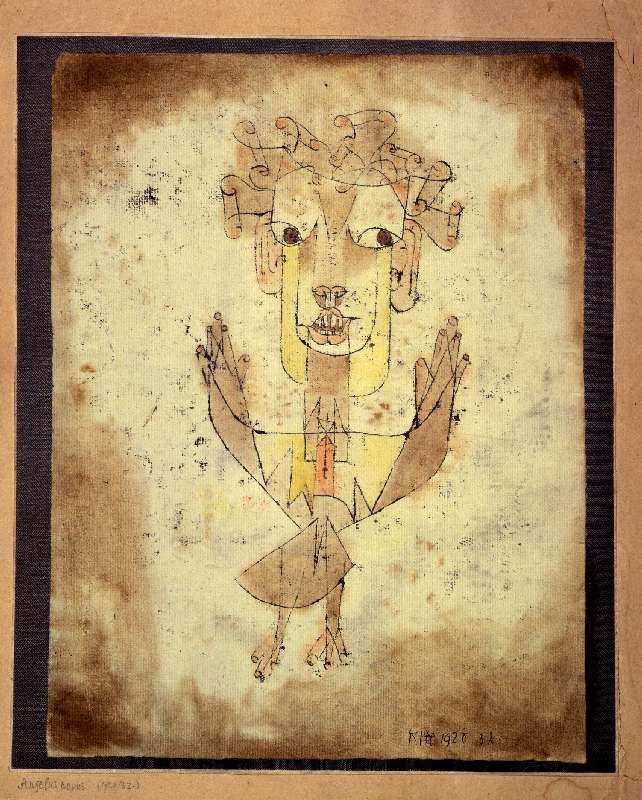
A Klee painting named Angelus Novus shows an angel looking as though he is about to move away from something he is fixedly contemplating. His eyes are staring, his mouth is open, his wings are spread. This is how one pictures the angel of history. His face is turned toward the past. Where we perceive a chain of events, he sees one single catastrophe which keeps piling wreckage upon wreckage and hurls it in front of his feet. The angel would like to stay, awaken the dead, and make whole what has been smashed. But a storm is blowing from Paradise; it has got caught in his wings with such violence that the angel can no longer close them. The storm irresistibly propels him into the future to which his back is turned, while the pile of debris before him grows skyward. This storm is what we call progress.
But let’s say we’re really, really bold. In our concept-generation we’ve seen not just the possibility of a better conceptual scheme but have glimpsed, as though rays of light cutting through the dark and looming canopy, some final judgment which might be rendered upon us. One need not articulate what this judgment consists in, but only point out that some trend or feature of our conceptualization pushes us toward a determinate conclusion of thought. Given enough knowledge about certain mathematical series (1/2, 1/4, 1/8, 1/16…), though certainly not an exhaustive listing of all of its members, one can after all ascertain that it yields a determinate sum (in this case, 1). In this case we stand with Hegel, who took it that reasoning would yield some Absolute which fully justified its own grounds. This Absolute would constitute a conceptual scheme fully adequate to a criterion of adequacy derived from itself.
In either case, regress plummets us from extravagant heights. We may not wish to take the leap. Denying the regress means denying that the adequacy of our conceptual schemes derives from other conceptual schemes. In other words, it involves accepting the primacy of the non-conceptual in determining the success of the conceptual. Such was the critique Marx levelled against his fellow Young Hegelians: they took the realm of thought to be independent of the material context in which it took place, believing genuine progress (philosophical or otherwise) to be possible merely by thinking through the concepts involved. Rather, Marx argued, critique must refer theories to the conditions of their genesis. Regardless of how a given theoretical position conceived of its goals and commitments, what was essential was to examine the actual ends to which its theory was put – the actual social function it played, or could play – as well as how its specific positions and arguments were made possible by and expressive of the real social conditions which produced them. It is not that our concepts are the means by which we make the world intelligible – quite the opposite. The world renders our concepts intelligible and provides them with a criterion of adequacy.
Take, for example, divine command theory as a conceptual schema for organizing political life during feudalism. Political authority flows from the king, as the representative of God’s will on earth, down through the princes and lords and knights all the way to the serfs who comprise the mass of society. Such a model of political organization, patently absurd to contemporary ears, was in its time legitimated not for its intellectual merits but for its plausibility to lived experience. Those in positions of power who each day made decisions governing the lives of those below them must indeed have found it plausible that their will on earth, functioning as it did like God’s in heaven, must have derived from the divine. Correspondingly those serfs who toiled for their masters due to happenstance of birth could at least make sense of their interminable labors as willed, if not by them, then by God. Feudalism as a conceptual scheme was overturned not (just, or fundamentally) because theorists discovered the possibility of a more equitable, secular society, but because the world it made intelligible had passed out of existence.
Whereas with the positions accepting regress we fell from lofty heights, with Marx’s position we seem not even possessed of a chance to attain them. For if conceptualization just reflects in thought the givens of material reality, then it becomes tempting to condemn it as a redundant fatalism. Thought, which from its outset strove to act as mirror to nature, finds itself always-already condemned to a derivative role. Its epistemic virtue – that thought might accurately describe the world – reveals itself an ontological vice, the crippling realization that wherever it looks it cannot but help stare unblinking at its double.
Stripping down to philosophical kernels (part 2)
But what exactly offends so greatly when we engage in philosophical stripping? Isn’t it rather the case that, as Aristotle puts it in his Ethics, “our discussion will be adequate if it has as much clearness as the subject-matter admits of, for precision is not to be sought for alike in all discussions, any more than in all the products of the crafts.” The insight here pertains to the contextuality of our inquiries: the method of our investigation and the precision of our measurement must respond to our subject.
Our imagined dispute between Adorno and Aristotle lies in their disagreement over the criterion for determining conceptual inadequacy. For Adorno, full adequacy could only (and inconceivably) arrive at the moment of total identity between thought and world, in which the object of our cognitive judgment is rendered bare to us in its entirety – in which thought becomes just as whole as the world which it reaches out to. Aristotle proceeds more modestly: full adequacy involves the proper sort of fit between thought and world, and what sort of fit that is involves an investigation of the object of thought and our own aims in thinking it. Particle physics admits of more precision in measurement than ecology, but this in no way means either field is more adequate to its phenomena. It is rather that to prove the existence of gravitational waves requires a two-and-a-half mile long apparatus sensitive to perturbations of “smaller than one-ten-thousandth the diameter of a proton (10-19 meter),” whereas to discover the detrimental effects of mercury on a particular ecosystem requires a different set of tools and standards.
At first glance Aristotle’s sensibly conservative view may seem to have the upper hand above Adorno’s impossibly demanding method. But, it turns out, we may not yet be off the hook. Two concerns give reason to push us from Aristotle to Adorno: the circularity of assessing conceptual adequacy by way of “proper fit,” and the reasonable notion that philosophy as a knowledge-domain ought not only give us insight about parts of the world, as particle physics or ecology might, but should rather present us with an account of the whole of the world in terms of what is most fundamental about it. The first concern, we’ll see, makes way for the second.
So let’s say we agree with Aristotle – our concepts are adequate insofar as they properly fit the subject matter they seek to describe. Well, what’s a proper fit? It seems we’ve just punted the question of adequacy down the field. Our goal was to discover the criterion for ascribing adequacy to concepts; our discovered criterion ends up being that a concept is adequate when it properly – or, should I say, adequately – fits the object we are conceptualizing. But this sort of adequacy was precisely what was at stake in our deliberation, and our criterion seems to come up empty.
What would it possibly mean for a conceptualization to be adequate to its subject matter? Suppose we have a model like this: when thinking about some subject matter S, our conceptualization of it C is adequate just in case it meets our criterion of adequacy R. For example, when we think about the existence of gravitational waves, our conceptualization of that existence involves (among other things) a sensitivity to instrumental perturbations of 10-19 meters, and so meets our criterion of adequacy involving standards of precision and accuracy (among other things). But, for any conceptualization, how do we determine the criterion of adequacy R? How do we know, for example, that our concept of gravitational waves must be sensitive to one standard of measurement, but our concept of an omelette does not? None of us, I hope, measures out the egg content of their omelette to the attometer. It seems, in other words, that we must have some criterion for choosing the correct criterion of adequacy R. But to choose such a criterion we’ll need another, and to choose that one we’ll need another, and to choose… well, it’s a long and unproductive tumble from there.
Stripping down to philosophical kernels (part 1)
To cut through the confusions of theorizing our world, messy as it is, philosophers strip – they remove features of the object of inquiry until they reach some essential kernel. These kernels offer enough meat for substantial conclusions and generalizations, without the mess of irrelevant contingency to hamper philosophical progress. Indeed, on some conceptions this just is what philosophy amounts to: stripping down and generalizing based on what’s left. For example, in discussions on ethics, one might treat human beings as moral agents insofar as they possess the capacity for rationality. All of those other features about human beings – their bodies, preferences, emotions, and what have you – are set aside by the ethical theorist for the purposes of their analysis.
Typical objections to the stripping method rely on the notion that something is lost when a thing is considered in terms of its particular essential kernel. When we take human moral agency to consist in the capacity for rationality, our account is defective insofar as we have left other things out of the picture. Stripping, in other words, is inherently reductive. Perhaps the most dedicated critique along these lines is Theodor Adorno’s negative dialectics, which argues that thought always fails to do justice to its object. Whenever we conceive of a particular object (or set of particular objects) under a concept, our conception necessarily fails to encompass the whole of that object (or set of objects).
For example, suppose I conceive of my feline companion, Bashir, as a cat. I will (quite accurately) capture the fact that Bashir is a four-legged, furry felis catus whose ancestors were quite revered in Egypt. But, I’ll fail to capture his propensity to beg for food by standing on his hind legs, as well as his particular sort of mercurial disposition toward baths. And, even the brief description I’ve just provided of those particularities invariably comes short of describing exactly who Bashir is.
For Adorno, the failure of our concepts to make good on their promises of rendering the whole of the world intelligible gives us a duty to engage in ongoing self-critique. Our failed conceptualizations produce suffering: first, of the sort that comes intrinsically from the inability of our conceptualization to make good on its implicit promise to adequately think the object of thought; second, of the sort that arises from the consequences of acting on such a failed theorization of the world. Though Adorno rejects the notion that we’ll ever reach a state of identity between thought and world (in which, as Hegel says, the real is the rational, and the rational the real), he does take it that we can move toward progressively less inadequate understandings. Indeed, such is the progress of philosophy.
 lacun(a)head